
Autism Evaluation & Diagnosis
Clarity can make all the difference. When questions arise about development, communication, behavior, or social interaction, a comprehensive evaluation can help provide answers. At Opal, we make the autism diagnostic process compassionate, thorough, and centered on understanding the whole person, not simply identifying a diagnosis.
Not sure whether your child needs an evaluation? Call us for a free clinical consultation — no strings attached.
When Caregivers Reach Out
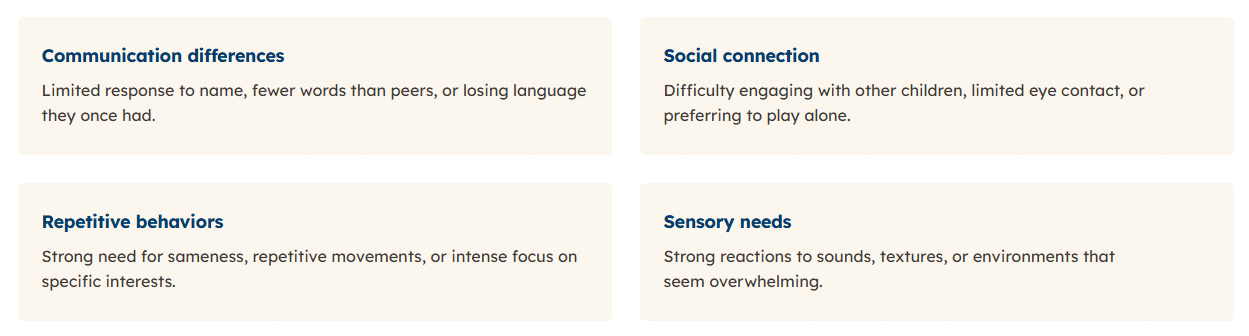
Every child is different. These are common reasons caregivers begin the evaluation conversation with us:

Evaluation with Compassion
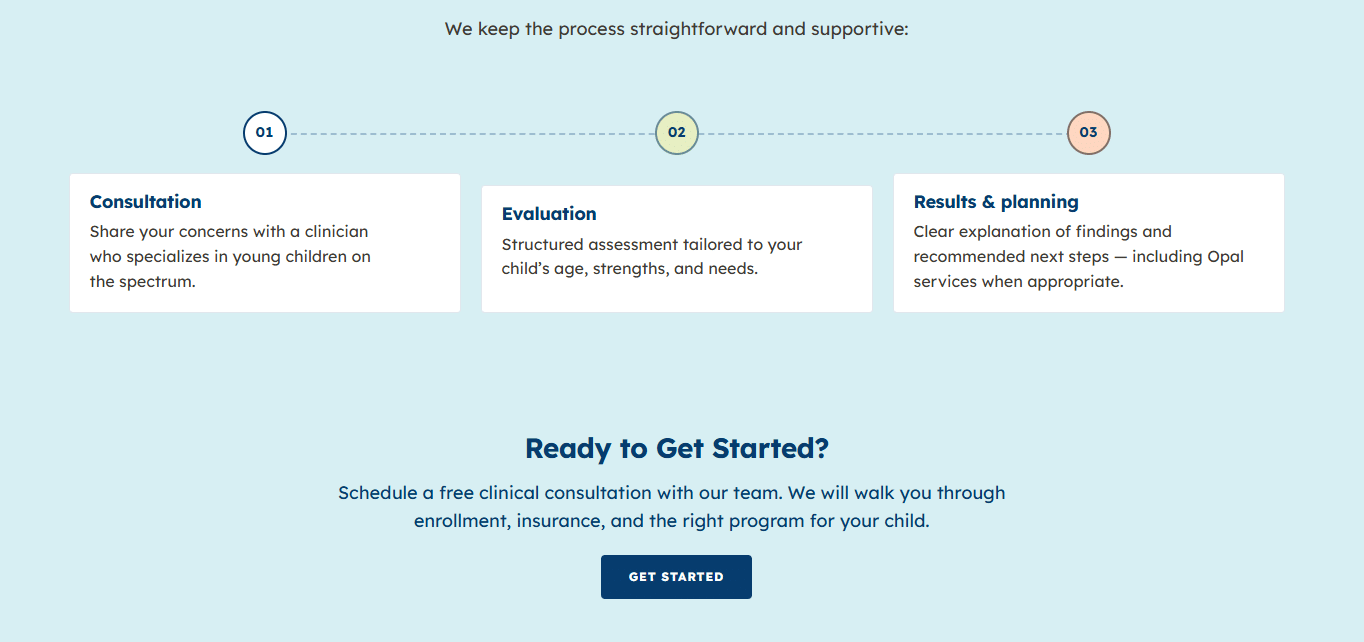
Our clinicians take time to understand each child in context — not just checklists. We explain what we observe, answer your questions in plain language, and help you understand what the results mean for your family.
If a child receives a diagnosis, we can connect you directly to Opal’s in person ABA therapy, or assist in coordinating a referral elsewhere — so you are not starting over with a new team.
How Our Diagnostic Services Are Delivered

Comprehensive autism diagnostic evaluations are conducted in person at one of our centers or via telehealth, depending on each child’s individual needs and what works best for caregivers.
What to Expect

Streamlined Intake
Our admissions team schedules your evaluation quickly and handles insurance verification before your first appointment. You won’t spend weeks on hold trying to figure out if you’re covered.

Collaboration with Your Child's Providers
We coordinate with pediatricians, schools, and other specialists so the evaluation draws on a complete picture — not just what happens in one 60-minute session.
Flexible Scheduling
We offer scheduling options that go beyond standard weekday hours so families with demanding work schedules can actually access the evaluation their child needs.
Dedicated Clinical Team
Our psychologists specialize specifically in diagnosing young children with autism. After the evaluation, they explain results in plain language and give you concrete next steps — not a report and a handshake.
Ongoing Support
Getting the diagnosis is the beginning, not the end. We stay with your family through what comes next — helping you understand the results and connect to the right services.
Not Sure If Your Child Needs a Full Evaluation? Start Here.
Waiting months for a diagnostic evaluation when you’re not even certain one is needed adds unnecessary stress. The M-CHAT-R is a free, validated 20-question screener designed for toddlers between 16 and 30 months. It takes about five minutes and tells you whether a formal evaluation is worth pursuing.
It won’t give you a diagnosis. What it gives you is clarity on whether the things you’re noticing are worth a closer look — and something concrete to bring to your pediatrician or to us.

What Happens During an Autism Evaluation
The word “testing” puts a lot of caregivers on edge. It sounds like your child is about to be judged — or that they could somehow fail. That’s not what this is.
An autism evaluation at Opal is conducted by a clinical psychologist who specializes in young children. Each child is observed through play — how they communicate, how they initiate or avoid interaction, how they respond to the clinician, and what happens in the unscripted moments between structured activities. Your child doesn’t need to prepare for this. The psychologist isn’t measuring performance. They’re watching for patterns that emerge naturally, which means the most useful data comes from your child just being themselves.
You’re in it too. Parents complete developmental history interviews and standardized questionnaires that give the clinician context the observation alone can’t capture. You’ve watched your child across thousands of situations we’ll never see. That history is essential to getting the diagnosis right.
When the evaluation is complete, you’ll receive a written report and sit down with your clinician to go through the findings. If autism is diagnosed, that conversation will include a clear explanation of your child’s specific profile — not a generic description of autism, but what it means for your child.
Diagnostic Testing
What Happens During an Autism Evaluation
Our evaluation runs across three appointments. Here’s what each one involves.
Step 1: Initial Intake (Telehealth/Zoom)
You meet with a psychologist — just you, no child required — to walk through your child’s medical, developmental, social, and academic history. This is the session where everything you’ve noticed gets documented. The pediatrician visit where something felt off, the behaviors that worry you at home, the milestones that came late or not at all. Your observations are the foundation the evaluation is built on.
Format: Virtual appointment via Zoom
Duration: 60 minutes (may vary based on prior records)
Your child: Does not need to be present
What’s next: Diagnostic testing is scheduled once intake is complete
A few things that make this session go smoothly:
→ Find a quiet, private space — this conversation covers a lot of ground
→ Log into Zoom a few minutes early and test your audio and video
→ Check your email before the appointment — we send rating scales in advance with the subject line “Opal: Please Complete this Parent/Caregiver Checklist”
→ If your contact information has changed, let us know before the appointment date
→ If your child has had a prior autism evaluation or has an IEP, bring copies — they give the psychologist important context
Step 2: Diagnostic Testing
Your child joins a Zoom appointment from home. A psychologist observes their language and social interactions through semi-structured play activities — things that look like games, not tests. What the clinician is watching for isn’t performance. It’s pattern. How your child communicates, how they respond to prompts, how they engage with another person, and what happens in the unscripted moments in between.
Format: Virtual appointment via Zoom
Duration: 60 minutes
Your child: Needs to be present
What “testing” looks like: Observation through play-based, semi-structured activities — not a pass/fail assessment
Time is also spent reviewing the rating scales completed before the appointment and discussing any questions or concerns that have come up.
Step 3: Feedback (Virtual/Zoom)
You meet with the psychologist to go through the results — what was observed, what it means, and what they recommend. If a diagnosis applies, this is where you hear it explained clearly. Ask every question you have. Ask the same one twice if you need to. The feedback session isn’t done until you leave with a real understanding of your child’s profile and a concrete sense of what comes next.
Format: Virtual appointment via Zoom
Written report: Emailed to you, typically the next day
After you receive it: Review it carefully — if questions come up, you can schedule a follow-up with the psychologist
Scheduling questions or haven’t received your Zoom link? Call our diagnostic scheduling line directly: (910) 446-1091, ext. 250. Use this number specifically for evaluation scheduling — confirming appointments, sorting out intake links, or asking what to bring. If you haven’t received your link at least one week before your appointment, don’t wait.
After the Diagnosis: What Comes Next
A diagnosis tells you what’s actually happening in your child’s brain — what’s driving the behaviors, what communication barriers are real versus assumed, where the gaps are. That information is what allows a therapy team to build a plan that addresses the right things in the right order, instead of working from a guess.
For most children diagnosed under age 6, early intervention ABA therapy is the recommended first step — started as soon as possible after diagnosis. Young children’s brains are more adaptable, which means earlier intervention reaches more. That’s not pressure. It’s biology.
Depending on what the evaluation shows, center-based ABA therapy, school readiness programming, or parent training may also be part of the picture. Your clinician will explain which combination makes sense based on your child’s profile specifically — not a standard recommendation applied to every family.
Already receiving services somewhere else? We can still provide the diagnostic evaluation and share findings with your existing providers.
Insurance Coverage for Autism Diagnosis
North Carolina and Idaho both require insurers to cover autism diagnosis and treatment. For most families, that means the evaluation costs little to nothing out of pocket — the financial barrier that stops a lot of people from moving forward usually isn’t as high as they expect.
We accept most major insurance plans, including TRICARE for active duty and veteran military families. Before your first appointment, our intake team verifies your benefits and handles prior authorization. If there’s a coverage issue, you’ll know about it before anything is scheduled.
If you’re not sure what your plan covers, a free consultation call is the fastest way to find out. We’ll pull up your benefits before you decide anything.
Call to check your coverage and schedule a free consultation. Our team handles the insurance — you focus on your child.
Common Questions About Autism Diagnosis
Evaluators who specialize in young children expect this. A child who is anxious, avoidant, or has limited communication isn’t a problem — how they respond to those challenges is itself useful clinical information. Lack of cooperation won’t invalidate the evaluation.
Our diagnostic evaluations are conducted by clinical psychologists who work independently of the therapy team. A diagnosis is given only when the standardized assessment criteria are met. If your child doesn’t meet those criteria, we’ll tell you clearly — and talk through what else might explain what you’ve been seeing.
When conducted by qualified clinicians using standardized tools, evaluations are reliable. The gold-standard diagnostic instruments have been validated across large populations. Clinical judgment is always part of the picture — which is why our evaluations combine direct observation, parent interview, and standardized measures rather than relying on any single tool.
Not to contact us. You can reach out directly to schedule a consultation and start the intake process. Some insurance plans require a physician referral for coverage purposes — our team will clarify what your specific plan needs during the intake call.
The process spans three appointments — intake, testing, and feedback. How far apart those sessions are scheduled depends on your availability and the clinician’s schedule. Our team will give you a realistic timeline during the consultation call.